
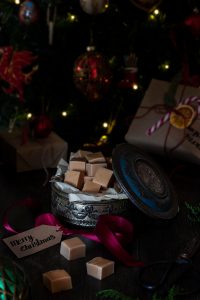
Baileys Fudge

It’s that time of year again when my kitchen returns to chaos as it transforms into a confectioners & production line of cakes & pies. There’s a thin dusting of flour on almost everything, splatters on the tops, clean tea towels are as rare as a dodo & sticky substances cling to the floor as I pray that no one I know dares to even entertain thoughts of popping over or dropping by. It can only be Christmas.

A time for merriment, gifting, indulgence & loved ones (plus tinsel obviously). An expensive month to say the least, but I’m a firm believer in homemade gifts. Not only does it keep costs down but it’s so much more personal to put time & effort into making something for someone that you know they’ll love.

Every year I make at least 4 cakes & puddings, batches of jams, chutney & fudge to gift to friends, family & the people that make me smile. The week before Christmas is a daze of marzipan & fondant (definitely don’t drop by then!).One of the firm favourites amongst my giftee’s every year though seems to be fudge. We all have a soft spot for a good fudge, it’s one of the most sought after & arugued over Quality Streets (after the purple one or maybe the green triangles of course).

Fudge is thought to be a descendent of tablet—a medium-hard confection from Scotland made in the same way as a fudge but using sugar, condensed milk, and butter . The two treats use similar ingredients, but fudge is richer, softer & has a less grainy texture.

Whilst you might believe that this rich, creamy confection originiated here in Britain though, it is in fact an American invention. The first recorded mention of a fudge was by a college student in 19th century America. She writes of being handed a recipe for the sweet which she makes for a college auction. The treat then became so popular that other students began developing their own recipes which they cooked over gas lamps in dormitories.

The actual origin of fudge, including it’s name however, is thought to be a complete mistake which occurred when a confectioner was making a batch of caramels & ‘fudged’ the recipe, giving birth to the fudge that we know today.

In Britain our fudge recipes now differ from our American cousins who tend to use whipped cream in place of butter & often add chocolate flavourings to theirs. Although fudge now comes in a variety of delightful flavours, often found in gift shops & tourist attractions across the country, each of questionable quality however as the term ‘fudge’ seems to have loosened in modern times to a confection made without boiling sugar or even made in a microwave (what have we become?).

I’m a traditionalist at heart though & believe that proper fudge should be made in the traditional way by boiling simply sugar, cream & butter to the perfect soft-set temperature (116C) before being beaten vigorously until your arms become jelly.
Each year I like to experiment a little by trying & making new flavours that I think each person will enjoy. This year, that led me to Baileys. The result is a deliciously sweet, creamy fudge with hints of creamy whiskey, the perfect gift for the Baileys lover in your life.

Baileys Fudge
- Author: Katie Lewis
Ingredients
- 450g caster sugar
- 400g double cream
- 50g butter
- 1 tbsp liquid glucose
- 80ml Baileys
Method
- 1. Place all of the ingredients, except the Baileys, into a large, heavy bottomed pan & add a sugar thermometer
- 2. Gently heat the mixture until the butter has melted & the sugar has dissolved
- 3. Bring the mixture to the boil & continue to boil for about 7-10 minutes until it reaches 90°C on the sugar thermometer
- 4. Remove the pan from the heat & add in the Baileys
- 5. Return the pan to the heat & bring back to the boil until the temperature reaches 116°C
- 6. Once reached, immediately remove from the heat & leave to stand for 5 - 10 minutes until the mixture has cooled to 110°C on the sugar thermometer
- 7. Begin to beat the mixture vigorously until the fudges begins to thicken into a ball of the temperature drops to 60°C
- 8. Pour the fudge out into a large 18cm x 18cm square silicone mould (or any shaped moulds you like) & leave to set before cutting
- Prep Time: 15 mins
- Cook Time: 15 mins
You Might Also Like:
Comments (2 Comments)
-
Mmmm love the baileys idea!!! This looks like the best dessert to indulge in!!!
-
It’s definitely indulgent! 🙂

Hi! I'm Katie!
This is a test placeholder and it will be updated
Leave a Reply